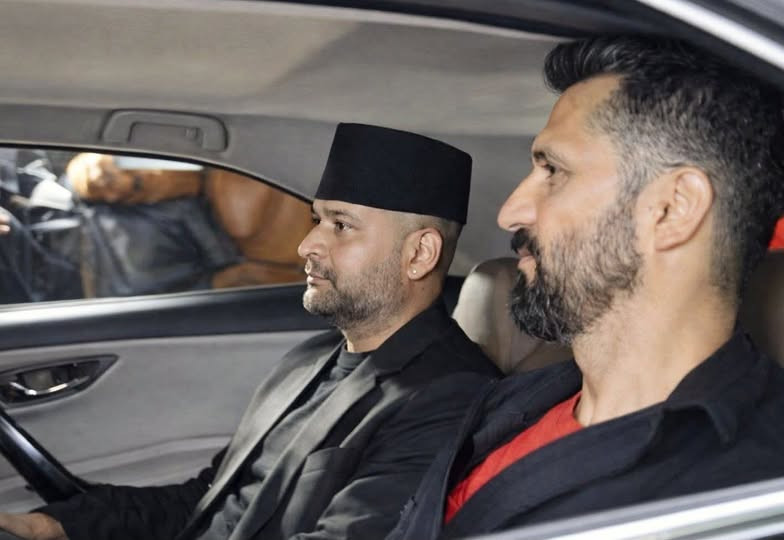
Kathmandu — As Nepal’s post–Bhadra 23–24 political landscape continues to evolve, meeting between Kathmandu Metropolitan City Mayor Balendra Shah (Balen) and Rastriya Swatantra Party (RSP) Chairman Rabi Lamichhane has once again drawn national attention to the possibility—and limits—of unity among emerging alternative political forces.
The talks, today held at the residence of Mayor Shah’s close aide Kumar Ben in Jwagal, Lalitpur, were watched closely not only by political insiders but also by a growing crowd of media persons, youth activists, and Gen-Z leaders gathered outside the venue. The symbolism of the meeting, the secrecy surrounding its content, and the guarded responses afterward have only deepened political speculation.
“What Does My Face Say?”: Rabi’s Cryptic Exit. After hours of discussion, Rabi Lamichhane exited the meeting quietly. When journalists pressed him for details, the RSP chair—known for his typically candid media interactions—offered an unusually evasive response. “What does my face say?” Lamichhane countered, refusing to elaborate.
When further asked whether future politics would be guided by the bell (RSP’s election symbol) or the baton (Lauro) (used by Balen during the Kathmandu mayoral election), Lamichhane replied briefly, “Time will tell. The talks went well.”
Beyond this, Lamichhane made no substantive comment, leaving behind more questions than answers. No official statement was issued by either side.
A Closed-Door Meeting, Literally and Politically
While the one-on-one talks continued inside, scenes outside the Jwagal residence were equally striking. Gen-Z activist Sudan Gurung, who was present at the venue, released a video message on social media claiming that the gate had been locked from the outside until an agreement was reached.
“Our two leaders are inside. This gate will not be opened until they made an agreement. We have the key,” Gurung said in the video, calling himself and others “guards” at the gate.
The gesture—half symbolic, half theatrical—reflected the heightened expectations among youth supporters who see Balen and Rabi as the twin faces of post-establishment politics in Nepal.
However, despite the pressure and public spectacle, those close to the discussions later confirmed that no concrete agreement on political unity or leadership structure was reached.
Who Came, Who Left: A Convergence of New Political Actors
The Jwagal talks were not limited to just Balen and Rabi. Over the course of the day and night, several political figures and activists arrived at the venue, underscoring the broader realignment underway in Nepalese politics.
Those present or arriving during the discussions included:
Shishir Khanal, senior RSP leader
Raksha Bam, prominent Gen-Z leader (who left shortly after Rabi’s departure, saying she would return later)
Amresh Kumar Singh, former member of the dissolved House of Representatives
Artists, civil society figures, and former lawmakers associated with alternative political currents
Raksha Bam later acknowledged her presence but refrained from disclosing details, reflecting the overall silence maintained by participants close to Mayor Shah.
Balen’s Expanding Political Homework
Although Mayor Shah has consistently avoided formal announcements about party formation, his recent activities suggest an intensification of political “homework.” Over the past weeks, Balen has held discussions with leaders from various political backgrounds, journalists, artists, youth activists, and former MPs.
Sources close to the mayor say these engagements are part of an effort to integrate new forces, particularly those energized after the unrest and political awakening of Bhadra 23–24.
Notably, people close to Balen insist that he has not committed to working under any existing party leadership, including RSP’s. This stance aligns with earlier signals from Kupandol meetings, where Balen reportedly emphasized leadership autonomy and the need for a new political structure rather than absorption into established ones.
Unity Desired, Leadership Contested
The Jwagal meeting has once again exposed the central tension within Nepal’s alternative political movement:
There is strong demand for unity, especially among youth and Gen-Z activists. But there is no consensus on leadership, structure, or electoral strategy.
While supporters hoped for a decisive breakthrough, the outcome appears to be another strategic pause rather than a merger.
Political observers note that Rabi Lamichhane’s cautious public messaging and Balen Shah’s continued silence both indicate awareness of the risks involved—premature unity without clarity could fracture support bases rather than consolidate them.
What This Means for Nepal’s Emerging Politics
The Balen–Rabi talks, dramatic as they appeared, underscore a deeper reality: Nepal’s post-establishment politics is still in transition, not yet institutionalized.
The old parties remain dominant but weakened. New leaders command public trust but lack shared frameworks.Youth-driven expectations are high, but organizational pathways remain unclear.
For now, the locked gate in Jwagal has reopened—but the political distance between Nepal’s two most watched alternative leaders remains unresolved. As Lamichhane said, “Time will tell.”
For Nepal’s voters, especially the post–Bhadra 23–24 generation, that time is approaching faster than ever.