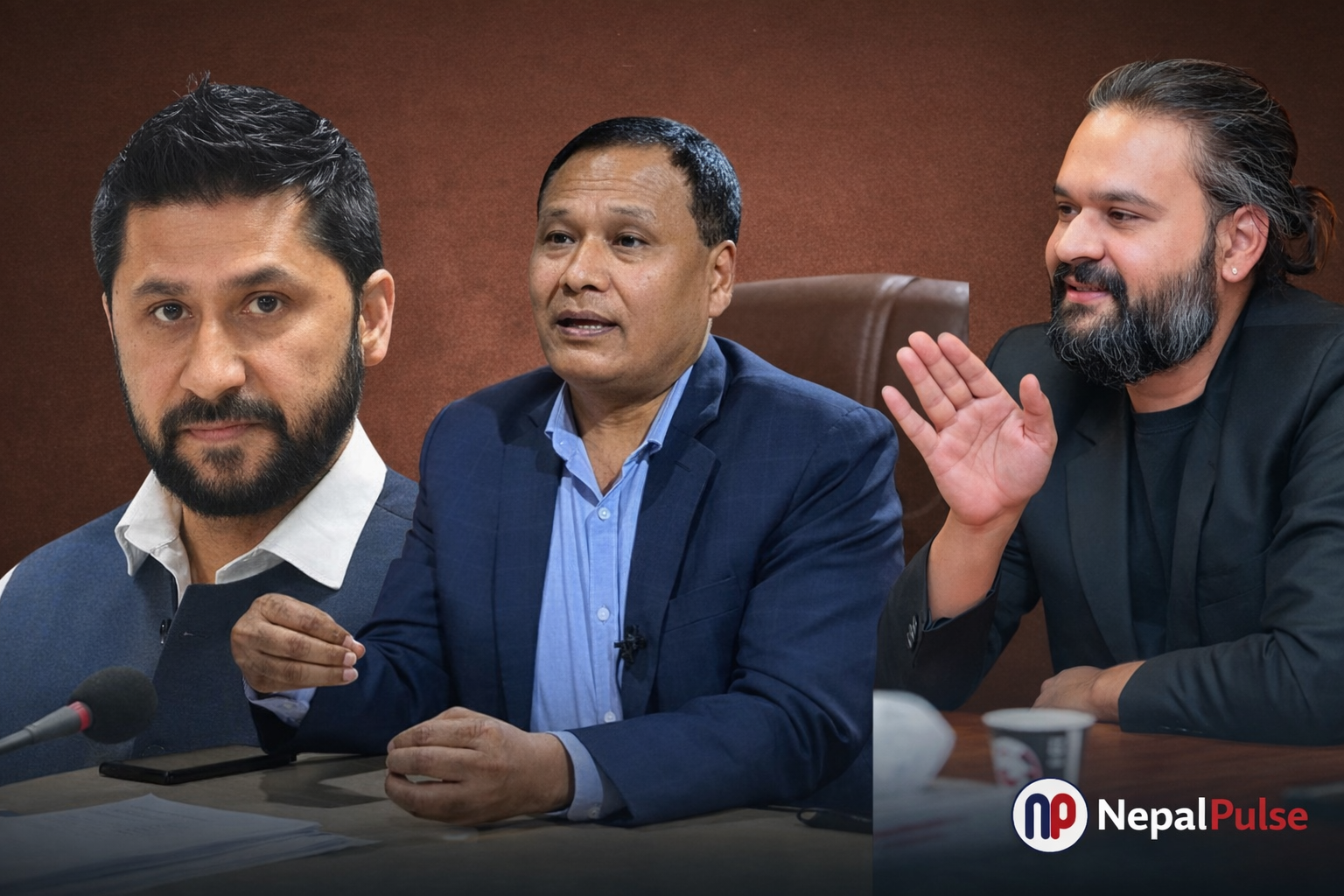
Kathmandu — After prolonged and intensive negotiations, Rastriya Swotantra Party (RSP) President Rabi Lamichhane and Kathmandu Metropolitan City Mayor Balendra Shah (Balen) finalized a seven-point unity agreement before dawn on Sunday. The agreement, however, left out Energy Minister and Ujjaya Nepal Party (UNEP) patron Kulman Ghising, despite his deep involvement in the talks until late Saturday night.
According to the agreement, the party’s name, flag, and election symbol will remain unchanged, Rabi Lamichhane will continue as party president, and Balen Shah will be projected as the future prime ministerial candidate. Kulman, who had been engaged in parallel unity talks with both leaders, ultimately walked out of the negotiations.
Talks break down at midnight
Kulman Ghising was present in decisive discussions with Balen at Baluwatar on Saturday night. Senior RSP leaders including Vice Presidents Swarnim Wagle and Dol Prasad Aryal were also part of the talks. The three leaders discussed unity possibilities late into the night, but Ghising left the meeting around 11:30 pm.
“After the issue could not be resolved, he left on his own,” a leader from the Ujjaya Nepal Party told Nepalpulse.
Following Ghising’s departure, Rabi and Balen continued talks and reached a final agreement at around 4 am on Sunday, formally signing the unity deal.
Early push to bring Kulman into RSP
After Lamichhane’s release from Nakkhu Prison, senior RSP leaders had actively pushed for Ghising’s inclusion in the party. RSP leader Shishir Khanal had even conveyed readiness to project Kulman as a prime ministerial candidate under a broader unity framework.
However, parallel discussions with Balen complicated the equation. Balen insisted that he himself should be the prime ministerial face, a position that ultimately shaped the final agreement.
Dispute over party leadership
Balen had initially proposed that Kulman be made executive president of the RSP, especially at a time when Lamichhane was in custody on charges related to cooperative fraud, money laundering, and organized crime.
With the Congress–UML government collapsing after the Gen-Z movement and the Sushila Karki-led interim government dissolving the House and announcing elections for Falgun 21, Balen believed that a combined front of Rabi, Kulman, and himself was essential to challenge traditional parties.
Since Lamichhane was in jail and unable to lead an election campaign, Balen proposed handing party leadership to Kulman. He even sent his close aide Kumar Byanjanakar to Nakkhu Prison with the proposal.
Lamichhane, however, flatly rejected the idea.
Trust deficit widens
Lamichhane’s refusal reportedly upset Balen, who then signaled support for Kulman and the Gen-Z forces. Subsequent negotiations explored a compromise, including a proposal to make Kulman acting party chair. Lamichhane again showed little interest.
Following this, Ghising registered the Ujjaya Nepal Party with the Election Commission under Anup Upadhyaya’s chairmanship. The party has since expanded its organization nationwide, with Ghising personally leading outreach efforts.
Silence after Rabi’s release
After Lamichhane’s release from prison, no public meeting between him and Ghising took place. Neither leader acknowledged any post-release interaction, a move the Kulman faction interpreted as deliberate sidelining.
In contrast, Lamichhane held multiple meetings with Balen, eventually forming a formal task force to finalize unity. The task force included Shishir Khanal and Asim Sah from RSP, and Bhupdev Shah and Kumar Byanjanakar from Balen’s side. Kulman and UNEP were completely excluded.
Leaders close to Ghising say this exclusion marked a turning point.
Kulman voices dissatisfaction
Ghising publicly expressed dissatisfaction for the first time after a meeting with Balen on Saturday. He stated that unity should not mean erasing others.
“Unity does not mean eliminating others,” Ghising said. “Everyone must understand the people’s wishes.”
He also indirectly questioned Rabi’s political standing, claiming public trust mattered more than organizational structure.
“They may have structure and resources, but trust of the people is decisive,” Ghising said. “Once that is achieved, everything moves forward.”
UNEP opts out of merger
Following the Rabi-Balen agreement, UNEP’s central committee decided not to merge with another party.
“We were flexible to the maximum extent,” a UNEP leader said. “But it became clear they did not want to move together.”
The party has now decided to pursue its own path, calling on alternative and progressive forces to unite under UNEP leadership.
“If necessary, we are even ready to give up the posts of president and prime minister,” a party leader said. “But unity must be respectful and inclusive.”
Moving ahead alone
Leaders close to Ghising say he now believes Lamichhane ignored UNEP’s flexibility and attempted to dominate the unity process.
“They formed a task force prioritizing Balen, but excluded us completely,” a leader said. “This was not unity between equals.”
UNEP is now focused on organizational expansion and election preparations. According to party sources, the list of proportional candidates will be finalized by Sunday.