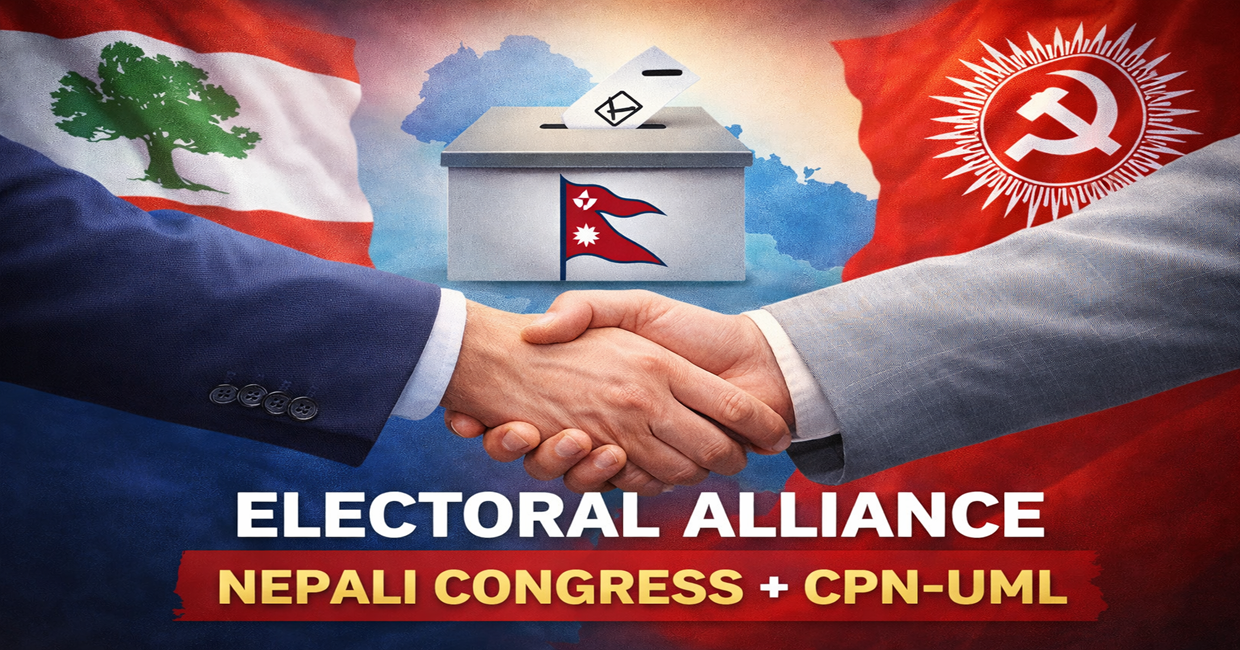
Kathmandu — Recent political developments have intensified speculation that Nepal’s two largest parties, the Nepali Congress (NC) and the CPN-UML, may form an electoral alliance in the upcoming national elections.
The speculation gained momentum after CPN-UML Vice Chair Ram Bahadur Thapa ‘Badal’ publicly advocated for a Congress–UML alliance, arguing that cooperation between the two parties is essential to safeguard democracy and national stability.
Speaking at a program in Kathmandu on Sunday, Badal said that a joint front between Congress and UML would be necessary in elections for both the House of Representatives and the National Assembly. He went further to propose a 50–50 seat-sharing arrangement across all 165 parliamentary constituencies, claiming such an alliance could decisively defeat what he described as “regressive forces.”
“We can restore and protect democracy only through a united movement of Congress and UML,” Badal said. “Only this alliance can ensure national independence and stability.”
The program was organized by a foundation affiliated with Madan Bhandari and led by Pradeep Gyawali, a leader close to UML Chair KP Sharma Oli. Oli was the chief guest, while speakers included Badal, Nepali Congress leader Min Bahadur Bishwakarma, and Kathmandu Metropolitan Deputy Mayor Sunita Dangol.
Although Bishwakarma stopped short of explicitly endorsing an electoral alliance, he acknowledged that cooperation with UML may be necessary to reach a broader political settlement. A close ally of Congress President Sher Bahadur Deuba, Bishwakarma recalled past cooperation between the two parties, including during the democratic movements of 1990 (2046 BS) and 2006 (2062/63 BS).
UML Chair Oli also hinted strongly at post-election cooperation, stating that the next government would inevitably be formed by the Congress and the UML. “Is it even possible for any other force to form a government?” Oli asked rhetorically, dismissing speculation about alternative leadership emerging from newer political figures.
The political significance of the event was heightened by the fact that only Congress and UML leaders were invited to the discussion, reinforcing perceptions of behind-the-scenes coordination. Analysts note that the presence of leaders close to both Deuba and Oli suggests more than casual dialogue.
This is not the first time such cooperation has been signaled. Oli previously became prime minister with Congress support under a controversial seven-point agreement, despite both parties being the largest in Parliament—an arrangement that defied conventional parliamentary practice. That agreement had also hinted at longer-term collaboration, including constitutional amendments and future power-sharing.
However, shifting political equations—particularly following the collapse of that arrangement—temporarily stalled such plans.
Meanwhile, new political forces have begun reshaping the electoral landscape. Figures such as Rabi Lamichhane, Kathmandu Mayor Balen Shah, and former NEA chief Kulman Ghising have emerged as symbols of public dissatisfaction with traditional parties. At the same time, regional and ideological blocs are regrouping: Madhes-based parties are reuniting, Harka Sampang has launched an aggressive campaign in Dharan, and Pushpa Kamal Dahal (Prachanda) and Madhav Kumar Nepal have formed a new communist coalition by merging more than a dozen smaller parties.
Amid this growing polarization, UML leaders have increasingly framed cooperation between major parties as a national necessity. UML General Secretary Shankar Pokharel has warned of rising geopolitical risks, arguing that Nepal could be pushed into instability if major constitutional forces fail to unite.
Building on this narrative, Badal’s explicit proposal for a Congress–UML electoral alliance has sparked debate within both parties and exposed internal divisions.
Nevertheless, political sources say the likelihood of an alliance has increased. According to these sources, Oli has proposed to Deuba an electoral alliance if elections are held, and political cooperation if the House of Representatives is reinstated.
Deuba appears receptive. Congress lawmakers—who have already endorsed participation in elections scheduled for Falgun 21—have also approached the Supreme Court, seeking parliamentary reinstatement. While some senior Congress leaders oppose this move, Deuba has reportedly begun internal preparations for a possible alliance.
Sources say Deuba has advised close aides to remain ready, signaling that an electoral partnership with the UML is no longer a distant possibility but an active political calculation.