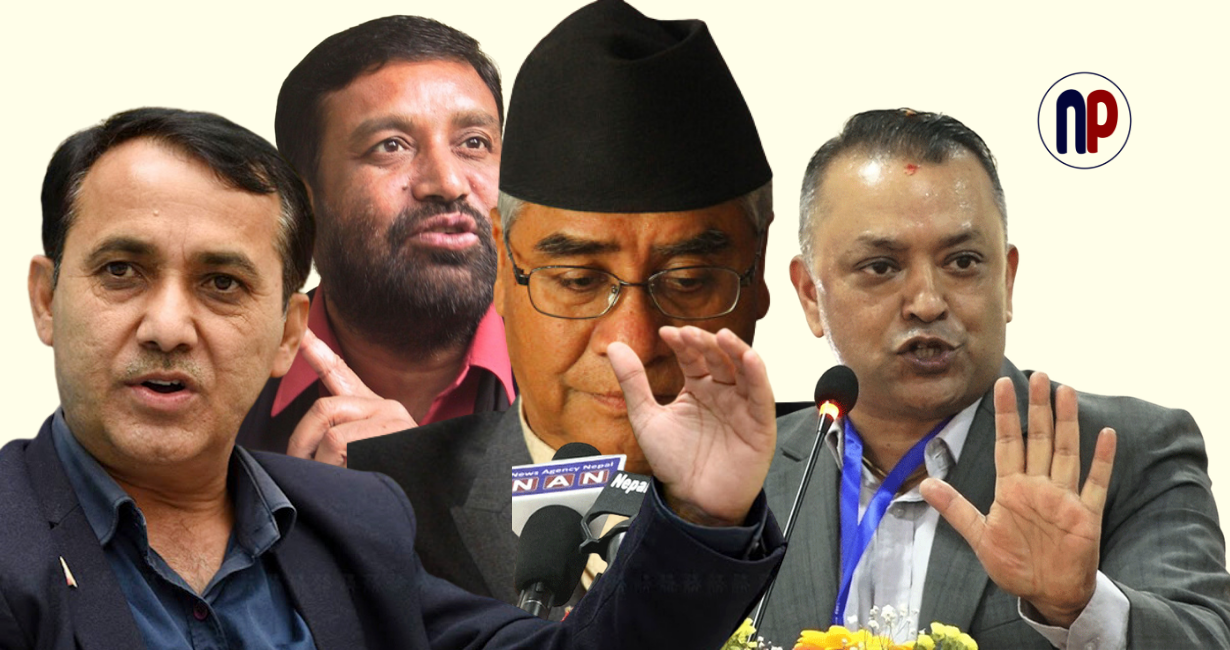
Kathmandu- Uncertainty continues over whether the special general convention of the Nepali Congress, called by General Secretaries Gagan Kumar Thapa and Bishwaprakash Sharma for Poush 27 and 28, will culminate in the selection of a new party leadership or be limited to policy-oriented resolutions.
Despite sustained pressure from reformist leaders and delegates, the two general secretaries have not categorically clarified whether leadership change will be formally placed on the agenda. The ambiguity has deepened after the party establishment announced that the 15th regular General Convention will be held on Baisakh 28–31, causing hesitation among grassroots delegates who are preparing to travel from districts to Kathmandu for the special convention.
Speaking on the objectives of the special general convention, General Secretary Thapa said the ultimate direction would be determined by the convention hall itself.
“Whatever decision the hall makes will be binding. If the hall decides to elect leadership, I cannot reject it,” Thapa said, adding that he personally believes both policy and leadership reforms are necessary. However, he stressed that it is not appropriate to pre-empt the authority of the convention by declaring outcomes in advance.
Thapa indicated that the Central Working Committee is unlikely to formally endorse the special general convention, effectively compelling the reformist group to establish its own procedures and move forward independently.
“We are saying that policies and leadership must change. Where and how that happens will be decided by the convention,” he said.
Three possible outcomes
Devraj Chalise, a key leader advocating the special general convention, said the initiative is currently navigating three possible outcomes. According to him, the first priority remains substantive reform driven by delegates demanding radical change within the party. The second possibility is coordination with the party leadership under pressure from signatures and mobilization.
“So far, there are no clear signs of coordination, but the door is still open if the leadership engages from the convention hall,” Chalise said.
He warned that if coordination fails, the decisions made by the convention hall would be considered final. Subash Pokharel, another prominent supporter, echoed this view, stating that consensus would be preferable but majority decisions would prevail if consensus is unattainable.
“If we secure a majority, we will make decisions. If not, we will pass resolutions and take them to the regular General Convention,” Pokharel said.
Nima Giri, also aligned with the special general convention, said party president Sher Bahadur Deuba’s participation could determine whether the gathering ends with resolutions or transforms into a decision-making forum.
“If President Deuba comes to the hall, the convention can conclude with unified decisions. Otherwise, the hall will decide its own course,” she said.
Diverging positions within leadership
While General Secretary Thapa appears open to all outcomes endorsed by the hall, General Secretary Bishwaprakash Sharma is reportedly opposed to electing leadership through a special general convention. Leaders close to Sharma say his position favors concluding the gathering as a resolution conference to avoid institutional complications and party division.
Both general secretaries, however, have publicly emphasized that the special general convention will not lead to a party split. Sharma reiterated that the initiative is aimed at shaping a “Congress suitable for changing times” and dispelling fears of internal rupture.
In contrast, leaders from the party establishment remain skeptical about resolving the dispute through dialogue. The Central Working Committee has reiterated its earlier decision that the relevance of the special general convention has ended and has instructed delegates not to participate, a stance reaffirmed through a formal decision on Thursday.
Key agendas of the special general convention
According to organizers, four major agendas will be discussed:
- Policy and leadership reform
- Review of contemporary political developments, including the events of Bhadra 23 and 24
- Structural reforms within the party, including proposed amendments to the party statute
- Review of Nepal’s foreign policy and international relations
Leader Ramesh Dhamala said the convention would conduct a serious review of recent political unrest and repression, and also revisit the party’s stance on electoral alliances—an issue previously addressed by the Mahasamiti meeting.
Proposed structural reforms include expanding representation by making ward-level office bearers regional representatives, granting voting rights to regional delegates with weighted provisions, and ensuring age-group representation within party bodies.
Financial preparations
Organizers estimate that around Rs 20 million will be spent on the two-day convention at Bhrikutimandap. Preparations are being managed by 12 to 21 subcommittees. Approximately 1,500 hotel rooms have been booked across Kathmandu, with accommodation costs alone estimated at Rs 6.75 million. Catering expenses are projected at around Rs 10 million, while stage construction is expected to cost up to Rs 800,000.
As the party has not officially recognized the special general convention, no funds will be drawn from the Nepali Congress treasury. Instead, expenses are being covered through voluntary contributions from general convention delegates, with organizers claiming that Rs 20–30 million will be raised internally.
General Secretary Thapa has urged cadres and the broader public to view the special general convention not as a power struggle but as an ideological debate about the party’s relationship with society.
“Without changing ourselves, we cannot claim to change the country,” he said, calling on reform-minded citizens to engage with the discussions scheduled for Poush 27-28.