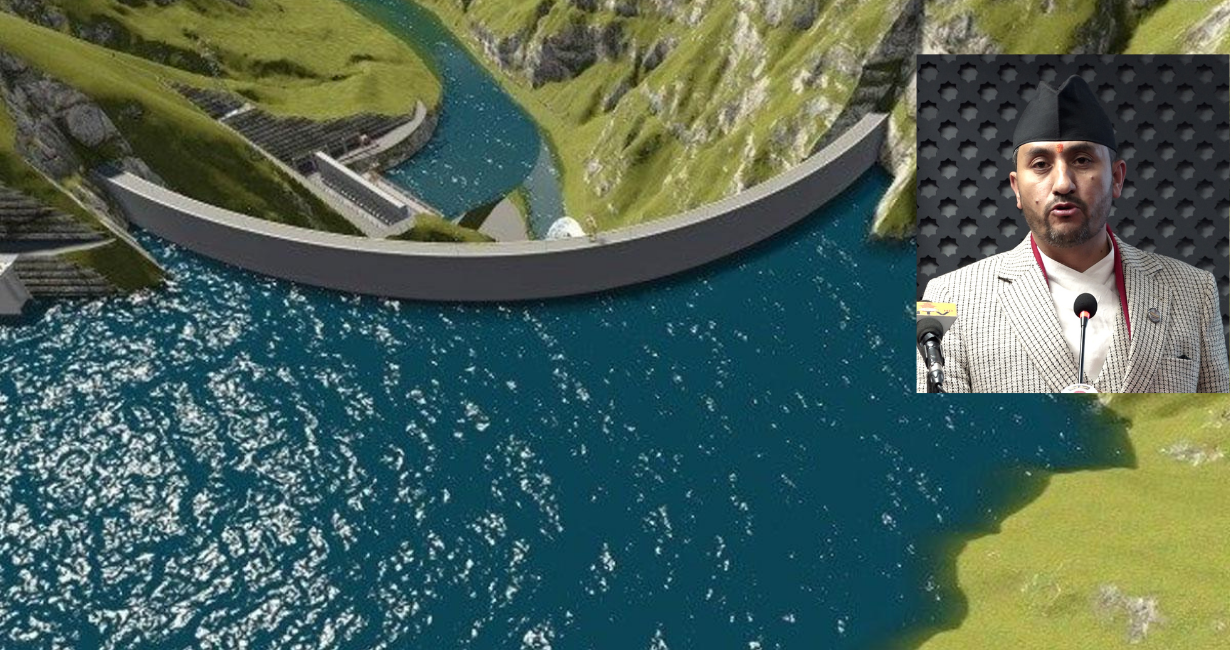
Kathmandu- The Council of Ministers has approved the investment and ownership modality of the Budhi Gandaki reservoir-based hydropower project, a national pride project to be constructed in Dhading and Gorkha districts. Under the approved framework, the Government of Nepal will hold an 80 percent share in the project promoter company, Budhi Gandaki Hydropower Company Limited, while the Nepal Electricity Authority (NEA) will own the remaining 20 percent.
Minister for Communications and Information Technology Jagadish Kharel, announcing the decisions of the Cabinet meeting held on Sunday, Magh 20, said the Council had endorsed the financial investment framework of the Budhi Gandaki Reservoir Hydropower Project.
According to the government, the proposal was forwarded to the Cabinet by the Ministry of Energy after reaching agreement with the Ministry of Finance and the National Planning Commission on the investment framework.
Earlier, outgoing Minister for Energy Kulman Ghising had stated on social media that the investment framework had been approved by the Finance and Energy-related bodies, describing it as a major achievement of his 115-day tenure. “There is no room for delay now. Work must begin. This project is not only for electricity generation, but a strong foundation for national self-reliance,” Ghising wrote.
Project cost and financing structure
The basic construction cost of the Budhi Gandaki reservoir hydropower project is estimated at USD 2.77 billion (approximately Rs 374 billion). Including interest during the eight-year construction period, the total project cost has been estimated at around Rs 406 billion.
The approved modality is based on a 70:30 loan-to-equity ratio, calculated on the total project cost including construction-period interest. Of the total equity, the Government of Nepal will invest 80 percent, while NEA will contribute 20 percent.
The government is set to invest a total of Rs 248 billion in the project, including Rs 97.47 billion as equity and around Rs 150 billion in concessional loans. The Cabinet has also agreed in principle to convert the approximately Rs 45 billion already invested by the government into equity shares of the project company.
In addition, the government has proposed to reinvest the amount collected as customs duty and value-added tax during the construction period into the project itself. It has also proposed allocating 50 percent of the infrastructure tax collected at customs points from petroleum product imports to the Budhi Gandaki project.
The government has sought to ensure a guaranteed funding source of Rs 228 billion for the project, while gradually restructuring its investment obligations. NEA will invest Rs 24.37 billion as equity.
To reduce financial costs and improve feasibility, the government has proposed issuing energy bonds worth Rs 30 billion, calculated on the basis of the mandatory liquidity ratio, with government facilitation. These bonds will be purchased by banks and financial institutions, insurance and reinsurance companies, and public funds.
Commercial banks are expected to provide loans worth Rs 104 billion, while co-financing is proposed from institutions such as the Employees Provident Fund, Citizens Investment Fund, Social Security Fund, insurance and reinsurance companies, Hydroelectricity Investment and Development Company Limited (HIDCL), Nepal Telecom, and other banks.
Power generation and revenue projections
The Budhi Gandaki project is expected to generate a total of 3.38 billion units of electricity annually, including 1.41 billion units during the dry (winter) season and 1.97 billion units during the monsoon season.
The proposed power purchase rate is Rs 12.40 per unit during the winter season and Rs 7.10 per unit during the rainy season. Based on these rates, the project is projected to generate annual revenue of approximately Rs 31.48 billion once electricity production begins.
The electricity generation license is proposed for a period of 50 years. If the project is completed within the targeted eight-year construction period, power generation would continue for the remaining 42 years of the license term.
Project status, land acquisition, and impact
The Ministry of Energy has stated that preparation of the detailed project report (DPR) and tender documents is currently underway. Land acquisition—considered one of the most complex components of the project—has been completed by around 90 percent.
So far, approximately Rs 42.65 billion has been distributed as compensation to landowners for land, structures, plants, and crops. The project will have physical and economic impacts on 8,117 households in Dhading and Gorkha districts, of which 3,560 households will be fully displaced.
From an energy security perspective, the project is considered strategically important due to its proximity to major electricity load centers such as Kathmandu, Chitwan, and Pokhara.
Under the project, a 263-meter-high curved arch dam will be constructed across the Budhi Gandaki River, which flows along the border of Gorkha and Dhading. The dam will affect areas corresponding to 14 former VDCs (now four rural municipalities and one municipality) in Dhading and 13 former VDCs (now four rural municipalities) in Gorkha.
Once completed, the reservoir will cover an area of about 63 square kilometers upstream. According to the Energy Ministry, the reservoir area is expected to create opportunities for employment, tourism development, fisheries, local businesses, and downstream benefits. The maximum water level of the reservoir is projected to reach 540 meters.