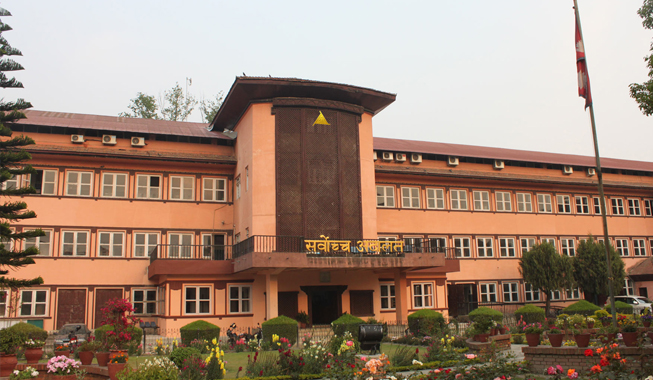
Kathmandu- Legal proceedings related to the dissolution of the House of Representatives and the dispute over the legitimacy of the Nepali Congress leadership are unlikely to move forward before the House of Representatives election scheduled for Falgun 21. Developments at the Supreme Court indicate that hearings on both matters are expected to take place only after the elections are concluded.
On Tuesday, the Supreme Court fixed Magh 28 as a general date in the case related to the dissolution of the House of Representatives. Meanwhile, in the case concerning the leadership legitimacy dispute within the Nepali Congress, the opposition parties have yet to be formally served a deadline to submit their responses.
According to court officials, Magh 28 has been set as a general date due to pending case management procedures in the dissolution case. Even if all procedural requirements are completed on that day, the earliest possible hearing could be scheduled only after two to three weeks, making it highly unlikely that the case will be heard before the Falgun 21 election.
Similarly, a writ petition filed by Nepali Congress leaders, including Sher Bahadur Deuba, challenging the Election Commission’s decision regarding the party’s leadership legitimacy remains pending. The Supreme Court issued a show-cause order on Magh 6, raising questions about whether an ongoing election process can be halted due to an internal dispute within a political party.
In its show-cause order, the court asked whether it is legally permissible to stop election-related processes already underway for the House of Representatives election on the grounds of a dispute over the legitimacy of party office bearers. This observation has effectively cleared the way for the election process to continue as scheduled.
Once the deadline is formally served, the Election Commission, Nepali Congress President Gagan Thapa, and Vice President Bishwaprakash Sharma—who have been named as defendants—will be given 15 days to submit their written responses. They may also seek an extension if necessary.
The Supreme Court has already declined to issue an interim order staying the Election Commission’s decision, although it has accorded priority to the case. The show-cause order notes that the matter involves serious legal and constitutional questions, opening the possibility of referral to the Constitutional Bench.
However, court officials indicate that as response deadlines have not yet been completed, substantive hearings are unlikely to begin for at least another month—effectively pushing both cases to after the upcoming elections.