kathmandu- With the House of Representatives elections scheduled for Falgun 21, more than 150,000 citizens across Nepal are set to receive over Rs 8 billion through temporary employment as election police. The funds are being channelled through the recruitment of election police personnel by the Nepal Police and the Armed Police Force, primarily as short-term deployment for election security.
For this purpose, the Ministry of Finance has granted resource consent amounting to Rs 8.5 billion. Of this, Rs 7.25 billion has been allocated for election police recruited by Nepal Police, while Rs 800 million has been earmarked for those recruited by the Armed Police Force. Nepal Police has appointed 133,980 election police personnel, while the Armed Police Force has recruited around 15,000. All have been deployed for a period of 40 days.
Election police personnel are paid salaries equivalent to police constables. According to Nepal Police, the daily wage is fixed at Rs 869.40, amounting to Rs 34,776 for the full 40-day period. In addition, each personnel receives a lump sum of Rs 846 as travel allowance for commuting to and from the deployment location. They are also provided with rations, uniforms and regional allowances. Those deployed in the Himalayan region receive clothing allowances of around Rs 11,000, those in the hills around Rs 7,000, and those in the Tarai slightly above Rs 6,000. On average, an election police personnel earns close to Rs 50,000 during the deployment period.
Many citizens are joining the election police not out of choice but due to economic hardship and rising unemployment. Shiva Kumari Devi, 53, from Bindabasini Rural Municipality-1 in Parsa, says she joined the election police mainly because of her family’s financial situation. She has previously worked as a temporary police officer in two elections. With one son injured in a road accident and requiring medical treatment, and two children still in school, she says the temporary income is essential for meeting household and medical expenses, while her husband relies on farming.
Similarly, Tetridevi Chamar, 32, also from Parsa, says she joined the election police hoping to earn money to support her children’s education. She says the work offers a rare opportunity to earn some income while also serving the country, even if only for a short time.
Economists say the short-term recruitment provides temporary relief but does not improve long-term living standards. Economist Dr Chandramani Adhikari notes that the 40-day employment helps households manage immediate expenses such as food, school fees, medical costs and loan repayments, but it cannot change economic conditions sustainably. He says the impact is more about crisis management than income transformation.
Economist Jitendra Upadhyay echoes this view, saying the temporary nature of the job means it has no lasting effect on employment or the overall economy. He says the income provides brief relief but does not create stable livelihoods, highlighting the severity of unemployment in Nepal. According to him, even if individuals manage to save or spend a few thousand rupees during deployment, the absence of regular income limits any long-term benefit.
Officials also point out that not all those recruited are economically vulnerable citizens, as a significant number are former security personnel, meaning a substantial portion of the benefits flow to those with prior institutional experience.
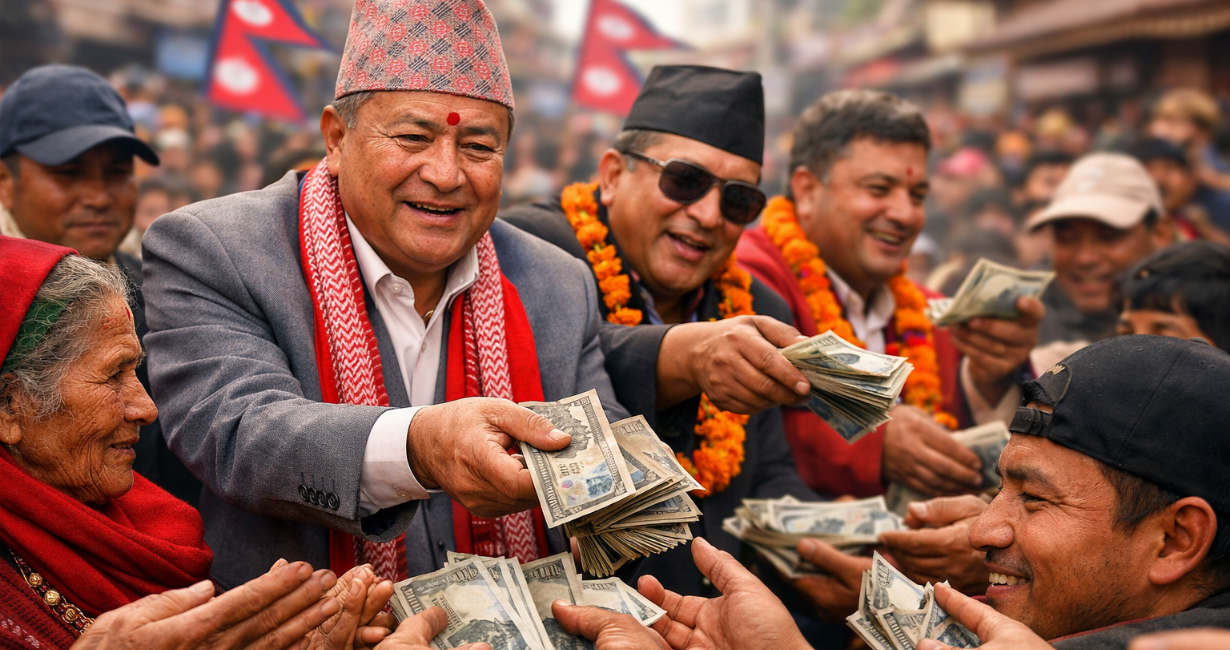
The broader economic context further complicates the picture. The Gen-Z movement alone is estimated to have caused losses of around Rs 84 billion to the government and private sector. In addition, the government has approved election-related expenditures worth Rs 19 billion. Political parties are also known to distribute cash during elections to influence voters, often sourced from undisclosed donations and business interests.
Economists warn that while election-related spending temporarily increases cash circulation and consumer demand, it often leads to post-election price hikes as businesses attempt to recover donated funds. As a result, they argue that although election spending briefly puts money into the hands of ordinary citizens, those same citizens ultimately bear the burden through rising inflation in the long run.