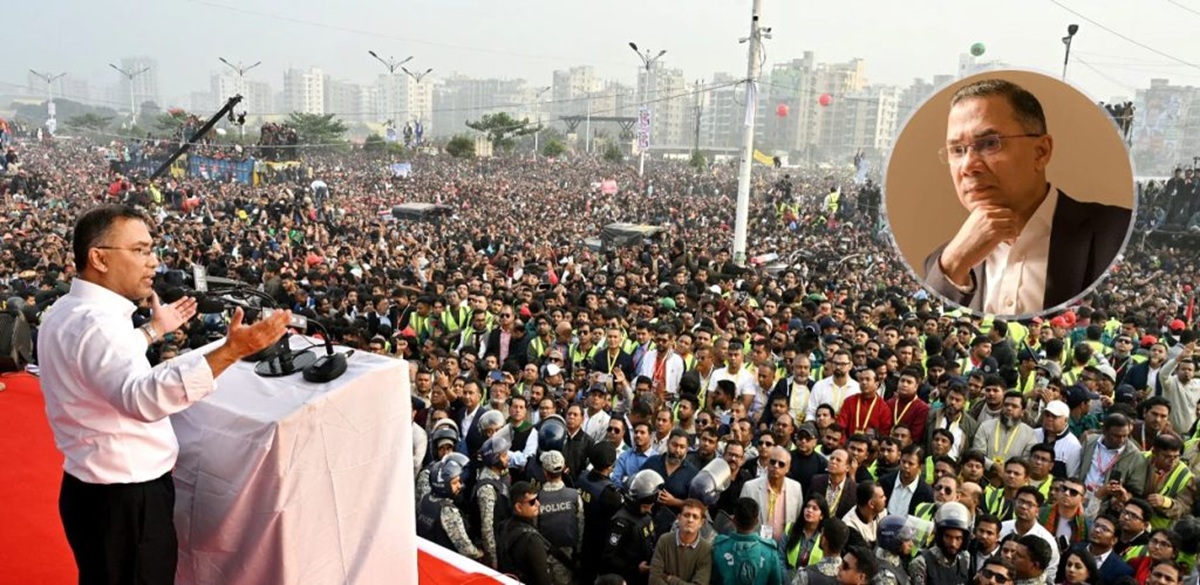
Dhaka- The Bangladesh Nationalist Party (BNP) has secured a decisive victory in the historic general elections, winning more than two-thirds of the 300 parliamentary seats and paving the way for party chief Tariq Rahman to assume the office of prime minister.
With over 200 seats confirmed, the result marks a dramatic political comeback for the Zia family and signals a major shift in Bangladesh’s political landscape following the July Revolution of 2024. The election outcome effectively ends nearly 15 years of Awami League dominance and positions 60-year-old Tariq Rahman as the central figure in shaping what supporters call a “new Bangladesh.”
Who Is Tariq Rahman?
Tariq Rahman was born on November 20, 1965, in Dhaka, then East Pakistan. He is the son of former President Ziaur Rahman, who declared Bangladesh’s independence as an army officer and later led the country until his assassination in 1981 during a failed military coup. His mother, Begum Khaleda Zia, went on to become Bangladesh’s first female prime minister and served multiple terms in office.

Rahman joined the BNP in 1988 and became actively involved in party organization and election campaigns during the 1990s. After the BNP returned to power in 2001, he rose to the position of joint general secretary and built a strong grassroots network. However, his rise was accompanied by mounting allegations of corruption and misuse of power.
During the BNP government’s tenure from 2001 to 2006, opposition leader Sheikh Hasina accused the administration of manipulating state institutions, preparing fraudulent voter lists and maintaining tacit links with extremist groups. The period ended in political turmoil, leading to a military-backed caretaker government in 2007 that launched anti-corruption drives.
Rahman was arrested on corruption charges and later allowed to travel to London in 2008 for medical treatment. He remained in exile for 17 years, running the BNP remotely while facing multiple court cases in Bangladesh. Courts convicted him in absentia in several corruption and money laundering cases, and Interpol issued a Red Corner Notice that restricted his travel.
Despite exile and legal setbacks, Rahman maintained influence within the BNP. During Sheikh Hasina’s rule, many BNP leaders were jailed, and his mother Khaleda Zia was imprisoned in 2018 following corruption convictions. She passed away in December 2025 after prolonged illness.
The July Revolution and Political Shift
The turning point came in 2024 when a student-led movement against the government’s quota system escalated into a nationwide uprising. The protests resulted in the resignation and exile of Sheikh Hasina after a violent crackdown that reportedly left over 1,000 protesters dead.
An interim government subsequently restructured the Election Commission, police administration and judiciary, and lifted many political cases filed during the Awami League era. These changes cleared the path for Rahman’s political return and the BNP’s participation in the latest election, from which the Awami League was barred.
BNP supporters portrayed Rahman as a victim of political persecution, and his exile narrative resonated strongly among voters, particularly younger citizens. The absence of the Awami League from the electoral contest further strengthened BNP’s prospects.
Challenges Ahead
Despite the landslide victory, Rahman faces formidable challenges. Bangladesh’s economy is under severe strain, with high inflation, declining foreign exchange reserves and currency depreciation affecting daily life. Reviving industrial production, easing import restrictions, boosting exports and attracting foreign investment will be immediate priorities.
Institutional reform is another critical task. Years of political polarization have deeply affected the judiciary, police and civil service. Restoring public trust and ensuring impartial governance will test the new administration’s credibility.
Law and order remains fragile following the upheaval of 2024. Managing tensions between BNP supporters and Awami League sympathizers will require careful handling to prevent further unrest.
On the foreign policy front, balancing relations with India, China and the United States will be crucial. While the previous government maintained close ties with New Delhi, Rahman is expected to recalibrate Bangladesh’s diplomatic strategy to secure economic and strategic interests. Relations with the US and Europe will remain vital, as they account for a substantial share of Bangladesh’s export markets.
The BNP’s sweeping mandate signals a profound political transition. Whether Tariq Rahman can convert electoral momentum into economic recovery and institutional stability will define the next chapter of Bangladesh’s political history.