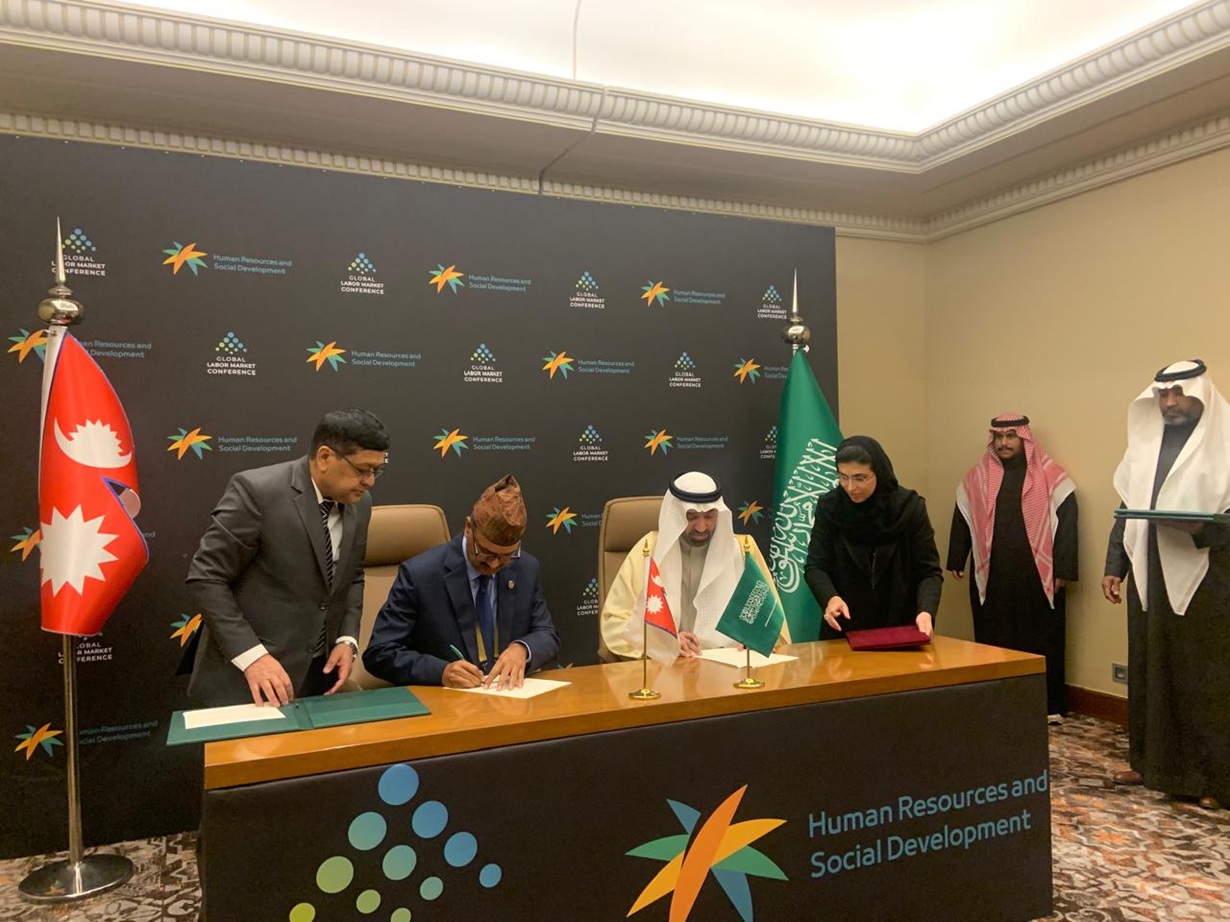
Kathmandu- Nepal and Saudi Arabia have signed a long-awaited bilateral labor agreement, 48 years after the establishment of diplomatic relations between the two countries, marking a major milestone in foreign employment cooperation.
The agreement was signed in Riyadh on Sunday night by Nepal’s Minister for Labor, Employment and Social Security Rajendra Singh Bhandari and Saudi Arabia’s Minister for Human Resources and Social Development Ahmed bin Suleiman Al-Razi. The deal aims to promote safe, organized, ethical, and dignified foreign employment for Nepali workers in Saudi Arabia.
Nepal and Saudi Arabia established diplomatic relations on March 15, 1977. Although labor migration between the two countries has existed for decades, this is the first formal bilateral labor agreement between them. With this agreement, Saudi Arabia becomes the 13th country with which Nepal has signed a labor agreement.
Nepal had been pursuing the agreement since 2070 BS, but negotiations were delayed for years due to disagreements, particularly over the issue of domestic workers. Saudi Arabia had pushed for the inclusion of Nepali domestic workers, while Nepal maintained its ban on sending domestic workers abroad, making such inclusion impossible. The Cabinet approved the agreement on 13 Bhadra, but political instability delayed the signing process.
The agreement focuses on ensuring ethical, systematic, and transparent recruitment of Nepali workers and protecting the rights of both workers and employers. It commits both countries to regulating the contractual relationship between workers and employers and establishing a mutually acceptable system for recruitment, mobilization, and repatriation of workers in line with international standards and domestic laws.
Both sides have agreed that recruitment will take place only through licensed recruitment agencies and authorized institutions operating legally and ethically. The agreement also commits both governments to regulating recruitment costs and preventing financial exploitation of workers. Recruitment agencies and employers are prohibited from charging workers any recruitment or deployment fees or making unauthorized salary deductions.
The agreement guarantees workers and employers the right to seek legal remedies in case of disputes and commits both countries to taking legal action against recruitment agencies or individuals who violate existing laws and regulations.
Under the agreement, Saudi Arabia is responsible for ensuring transparency in job offers, including clear details on job nature, qualifications, employment type, wages, benefits, accommodation, transportation, and end-of-service benefits. Employment contracts must clearly state terms and conditions and must be signed by both parties before the worker departs Nepal.
Saudi authorities are also responsible for protecting the rights and benefits of Nepali workers under Saudi law, ensuring salary payments through bank accounts in the worker’s name, facilitating 24-hour worker support services, resolving labor disputes promptly, and ensuring the dignified and timely repatriation of deceased workers in coordination with Nepali diplomatic missions.
Nepal’s responsibilities include health screening, skills training, legal orientation, and cultural awareness training for workers before departure. Nepal must ensure workers meet health standards, are free from communicable diseases, have no criminal records, and receive necessary vocational training and orientation on Saudi laws, social customs, and employment conditions.
Nepal is also responsible for encouraging workers to respect Saudi laws and social norms, complete their contract periods under fair working conditions, facilitate worker deployment within one month of visa issuance, and assist in the return of workers who violate Saudi laws or contract terms as per Saudi regulations.
The agreement establishes a Joint Technical Committee comprising at least three members from both countries to monitor, evaluate, and review implementation. The committee will hold consultative meetings alternately in Nepal and Saudi Arabia and may form subcommittees as required. Disputes will be resolved through consultation, negotiation, and diplomatic channels.
The agreement will remain valid for five years and will automatically renew for another five years unless either country formally notifies its intention to amend, suspend, or terminate it at least two months before expiry. Provisions of the agreement will continue to apply to contracts signed during the validity period even after the agreement expires.