Pokhara – The violent suppression of the Gen-Z demonstrations on the 23rd, which claimed 22 lives in Kathmandu and Itahari, plunged the entire nation into mourning and triggered widespread protests beginning early on the 24th. The destruction that followed shook provincial institutions as well, leaving significant repercussions for the Gandaki Province Assembly.
The Province Assembly building, its secretariat, committees, and party offices were burned to the ground. In total, 138 government offices and 61 private structures, including the Chief Minister’s Office and seven ministries, were damaged. Only the Agriculture and Health Ministries escaped destruction. With such extensive losses, the Assembly meeting scheduled for the 25th had to be postponed indefinitely.
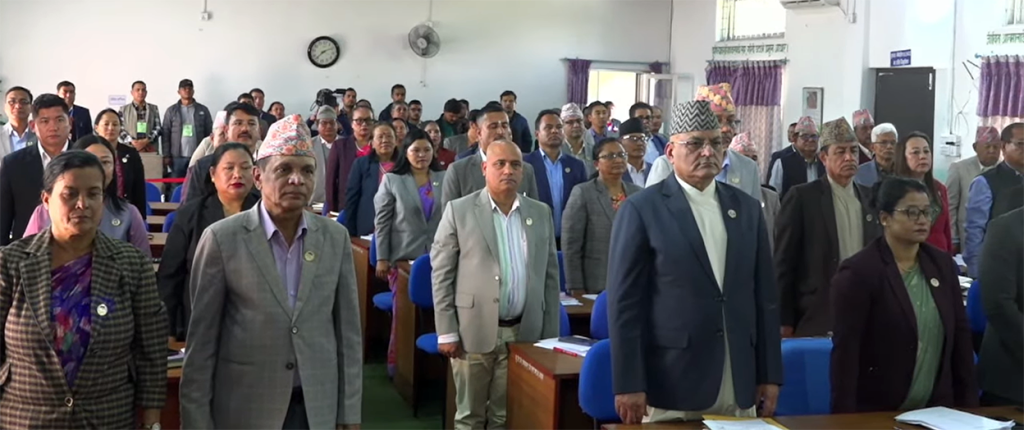
Following the replacement of the KP Oli–led federal government by a citizen-led administration under Prime Minister Sushila Karki, Gandaki Chief Minister Surendra Raj Pandey conducted field inspections and prepared to reconvene the Assembly. An initial attempt to hold the meeting on Asoj 24 at the Agriculture Ministry hall was cancelled due to unfavourable conditions. Exactly one month later, the Assembly finally convened in the same venue on Monday.
As per the earlier agenda, three bills were tabled: the amendment bill for Gandaki University Act, the bill on medicinal and industrial-use cannabis, and the mining bill. Although MPs were granted zero hour to speak, no special time was allocated. Lawmakers demanded such a session to fully discuss the Gen-Z uprising and its far-reaching impact. Many centred their remarks on the protests, while some used the moment to highlight local grievances and urge government attention.
Unlike the usual competitive rhetoric focused on constituency concerns and political advantage, MPs appeared unusually solemn. The chamber did not echo with partisan confrontation. Instead, the demand was unanimous: a thorough, structured discussion on the circumstances surrounding the Gen-Z movement, the devastation across the province, and the direction of future policy. Chief Minister Pandey briefed the Assembly on the scale of damage and the post-protest environment, addressing public expectations about how Gandaki lawmakers view the uprising.
Several UML lawmakers acknowledged the legitimacy of the Gen-Z demands but raised concerns about what they described as extremist infiltration. A few raised the issue of reinstating the Federal Parliament. Both UML and Maoist Centre MPs demanded special debate time. Congress’ youngest provincial lawmaker, Sunita Thapa, urged the Assembly to examine the root causes of the uprising.
Thapa emphasized that the dissatisfaction expressed by youth cannot be confined to the streets alone; it must be reflected in policy reform. “We must understand that frustration is not limited to public spaces—it must be translated into institutional change. Efficient service delivery, inclusion, safety, and justice for youth must be prioritised,” she said. She stressed that the youth movement was motivated by a desire for transformation, not destruction. The violence of the 24th should be analysed separately from the peaceful demonstrations of the previous day, she argued, adding that those who lost their lives did so in pursuit of change.
Call for Accountability
Although Wednesday’s Assembly meeting reconvened after earlier postponements, the absence of special debate time left MPs dissatisfied. Most insisted on a dedicated session to scrutinize the events of the 23rd and 24th, and to hold perpetrators accountable.
The Business Advisory Committee had already decided against allocating special time, limiting the session to the Chief Minister’s briefing. Nevertheless, MPs overwhelmingly demanded action against those responsible for the violence and destruction. UML lawmaker Ganeshman Gurung said the protests had altered Nepal’s political trajectory. “Where we were and where we have arrived—this must be discussed openly,” he said during zero hour. Gurung’s hotel had been attacked, looted, and set on fire on the 24th. Another UML lawmaker, Devaka Pahari Tripathi, also reported severe damage to her hotel.
MPs reiterated that the Assembly must fully debate the Gen-Z uprising, its impact, and the province’s roadmap forward, insisting that the issues raised by young citizens cannot be sidelined.