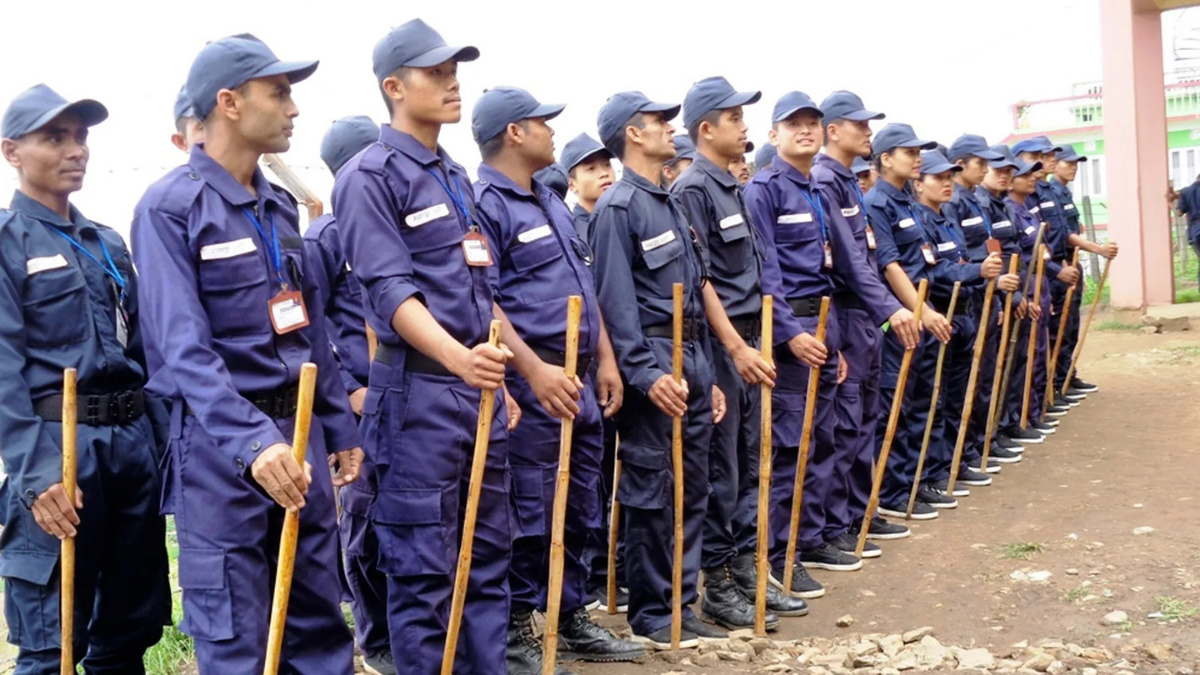
Kathmandu- The government has finalized the budget required to recruit nearly 150,000 temporary police personnel for the upcoming House of Representatives elections scheduled for February 21, as part of a broader effort to strengthen election security nationwide.
According to the Ministry of Home Affairs, both the Nepal Police and the Armed Police Force (APF) will recruit election police after the Ministry of Finance approved the long-pending budget proposal. The budget file, earlier forwarded by the Home Ministry, had remained under discussion for an extended period before receiving final clearance.
A Home Ministry official confirmed that the financial approval has removed the final hurdle. “With the budget now secured, the recruitment process for election police will move forward immediately,” the official said.
Over Rs 7.9 billion allocated for election police
Under the approved plan, the Nepal Police has been assured a budget of Rs 7.13 billion to recruit 133,980 election police personnel. This allocation is exclusively for temporary election policing and does not include the regular operational budget of the police.
Similarly, the Armed Police Force has been allocated Rs 808.453 million to recruit 15,110 election police personnel. With funding now ensured for both forces, recruitment procedures are expected to begin in the coming days.
Nepal Police to lead recruitment
The Ministry of Home Affairs has already granted formal approval for the Nepal Police recruitment quota, and the decision has reached Police Headquarters. Nepal Police Central Spokesperson and DIG Abinarayan Kafle said preparations are at the final stage.
“All internal processes have been completed. Applications for election police recruitment will be opened within a few days,” Kafle said.
Read this:- Around 80,000 Nepal Army Personnel to Be Mobilized for February 21 Elections
In the 2079 BS elections, around 115,000 temporary police personnel were deployed. This time, the number has been increased to 149,090, citing heightened security risks, increased voter numbers, unresolved cases of looted weapons, and escaped prisoners.
Rising security challenges
Officials point to the large-scale prison break during the violent incidents of 23 and 24 Bhadra as a key factor behind the expanded deployment. More than 14,000 prisoners escaped during those incidents, and over 4,500 remain at large.
In addition, 1,271 police weapons were looted during the unrest, with nearly half still unaccounted for. Authorities have also reported the loss of approximately 98,000 rounds of live ammunition, raising serious security concerns ahead of the elections.
Armed Police Force joins election policing
For the first time, the Armed Police Force will also directly recruit election police. While Nepal Police will deploy the majority, APF will recruit 15,110 personnel under a joint security arrangement approved by the Home Ministry.
The proposal was initiated after APF flagged shortages in manpower for election duties. Authorities say uniforms for election police under Nepal Police and APF will be different to ensure clear identification in the field.
40-day deployment period
As in previous elections, election police will be deployed for 40 days, receiving pay and allowances equivalent to the entry-level salary of a police constable. Eligibility criteria include Nepali citizenship, a minimum age of 18 years, and a maximum age of 54 years, with priority given to retired army, police, and armed police personnel.
Polling stations will be classified as normal, sensitive, and highly sensitive, with security deployment adjusted accordingly. Nepal Police and election police will form the first security perimeter, followed by the Armed Police Force in the second, and the Nepal Army in the final perimeter.
Nepal Army to be mobilized one month before polls
The Nepal Army will be mobilized one month prior to the elections, according to Army Spokesperson Assistant Lieutenant General Rajaram Basnet. He clarified that although approval is granted earlier, actual field deployment follows the established timeline.
The Central Security Committee has already approved the Integrated Election Security Plan 2082, which outlines security arrangements across pre-election, election-day, and post-election phases. Following recommendations from the National Security Council and the Council of Ministers, President Ram Chandra Paudel approved the mobilization of the Nepal Army on November 11.
Read this:- Falgun 21 Elections to Cost Rs 27 Billion, Security Alone Demands Over Rs 20 Billion
Authorities say the comprehensive security plan aims to ensure free, fair, and peaceful elections amid increasingly complex security challenges.