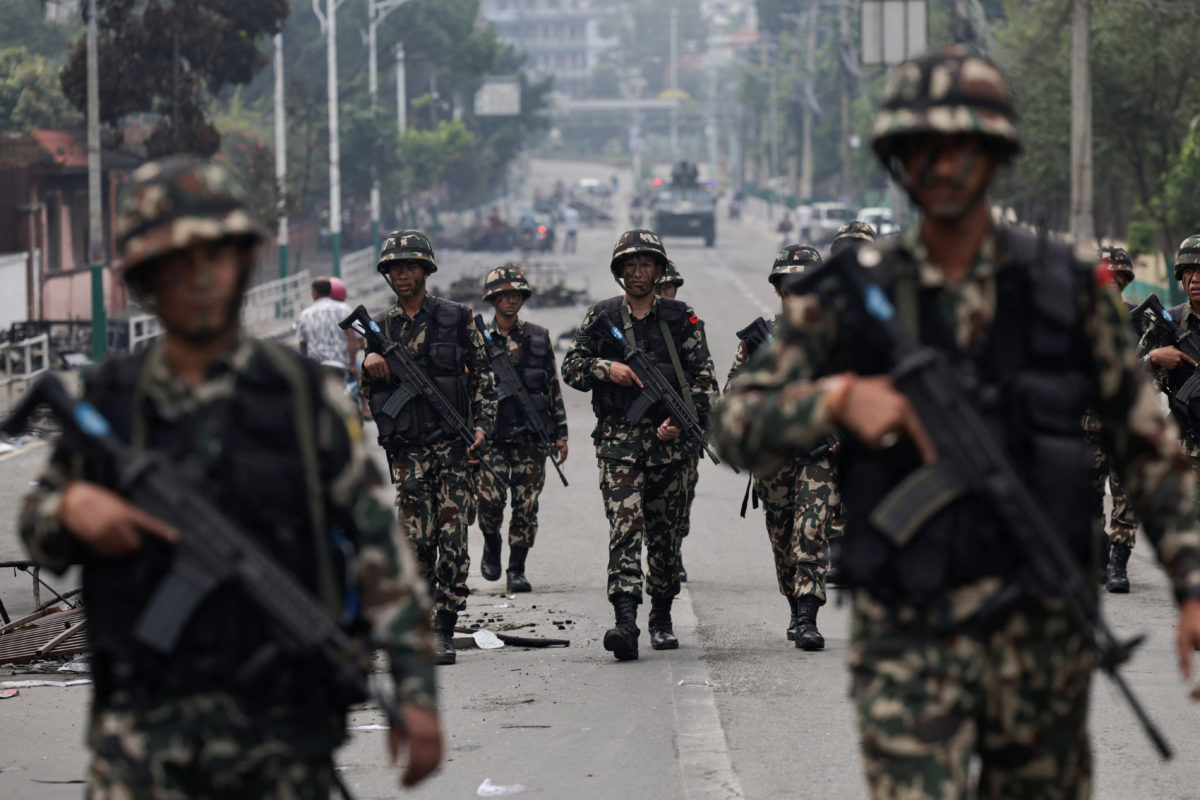
Kathmandu- The Nepal Army has begun assuming security responsibilities at key locations across the country as part of preparations for the House of Representatives elections scheduled for Falgun 21. The army has so far been deployed at 29 sensitive locations, including eight airports, with plans to extend its deployment to 53 additional sites in the coming days.
According to sources at the Ministry of Home Affairs, the Nepal Army will provide security at a total of 82 important structures during the election period. These include airports, prisons, courts, fuel depots, hydropower projects and key government offices—roles that were previously handled by the Nepal Police and the Armed Police Force (APF). Police personnel relieved from these duties are being reassigned to election-related security tasks.
Nepali Army Central Spokesperson Assistant Lieutenant Colonel Rajaram Basnet said the transfer of security responsibilities is being carried out as per the Integrated Election Security Plan and in coordination with district security committees.
“This is an operational process. Coordination is ongoing on how responsibilities are transferred and how long the army and police will jointly remain deployed, depending on local conditions,” he said.
Army Deployment at Airports and Prisons
As of Monday evening, the Nepal Army has taken charge of security at eight airports. These include Thamkharka Airport in Khotang and Rumjatar Airport in Okhaldhunga under Koshi Province, Rajbiraj and Janakpur airports in Madhesh Province, Bharatpur Airport in Chitwan (Bagmati), Tarigaun Airport in Dang (Lumbini), Nepalgunj Airport in Banke, and Surkhet Airport in Karnali. Coordination is underway to hand over security at additional airports as well.
The army has also taken over security at 15 prisons, including the Central Prison in Nuwakot. Other facilities now under army security include prisons in Udayapur, Okhaldhunga, Makawanpur (Bhimphedi), Chitwan (Bharatpur), Dhading, Rupandehi (Bhairahawa), Kapilvastu, Dang (Ghorahi and Tulsipur), Banke (Nepalgunj), Kohalpur (Naubasta), Bardiya, Palpa (Tansen), and Surkhet.
With the army assuming prison security, police personnel previously assigned there will be fully mobilized for election duties. The Nepal Army will also be responsible for transporting prisoners to courts and government attorney offices during the election period.
Security at Other Strategic Sites
The Nepal Army has also been deployed at the Amlekhgunj Fuel Depot in Bara, the 3B Hydropower project in Nuwakot, provincial government offices, the Provincial Assembly building in Janakpur, Dhanusha District Court, Janakpur High Court, and the District Administration Office in Dhanusha.
Earlier, the Armed Police Force had been providing security at several prisons, including Nakkhu Prison in Lalitpur. Preparations are underway to gradually hand over security at prisons in Sunsari, Morang, Mahottari and Parsa to the army. The army is also expected to take charge of Nakkhu Prison before the elections.
Election Deployment and Force Mobilisation
Under the Integrated Election Security Plan, the Nepal Army will provide third-tier security at polling stations nationwide. If required, the army may assume additional responsibilities in coordination with election officers and other security agencies. The army will also be involved in transporting ballot papers, ballot boxes after voting, and securing counting centres.
Given the unusual security situation following the Gen-Z movement, authorities have assessed heightened risks for this election. The government plans to mobilize approximately 80,000 Nepali Army personnel, 72,000 Nepal Police, 32,000 Armed Police Force members, and around 150,000 election police.
Once the election process concludes and the security situation normalises, the Nepal Army will gradually hand back security responsibilities to the police and return to barracks after the announcement of results.
The government has announced that elections will be held simultaneously in all 165 constituencies across the country on Falgun 21.