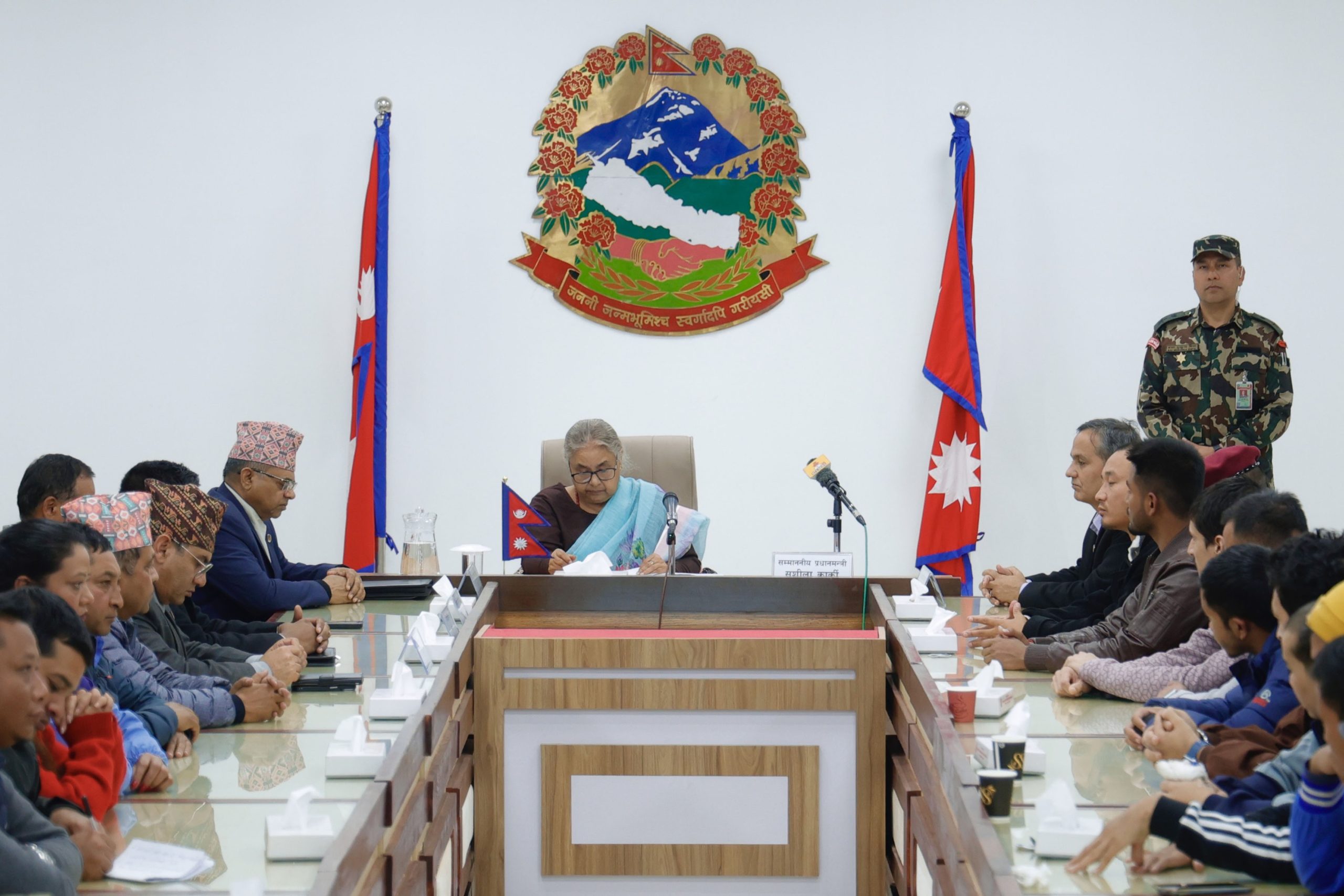
Kathmandu. The government has formally agreed to take ownership of the GenZ movement of Bhadra 23 and 24—an uprising that toppled major political forces and paved the way for the formation of an interim government under former Chief Justice Sushila Karki. Although the new government was formed in the immediate aftermath of the protests, a formal agreement between the state and GenZ representatives was concluded only three months later.
The youth-led, decentralized protests, triggered by public frustration with governance failures, did not present organized demands during the movement. As a result, concerns had grown over the possible dilution or misinterpretation of the issues raised. To prevent this, GenZ groups began pushing for an institutional framework to officially register their demands.


After prolonged negotiations, repeated review of a draft presented by the GenZ side, and rising pressure from the youth—who had warned of renewed nationwide protests—the two sides reached a ten-point agreement at Singh Durbar on Wednesday.
Below are the ten key commitments outlined in the agreement:
- Honor and Compensation for Martyrs and Injured
Victims of the Bhadra 23–24 protests will be declared martyrs. Families will receive compensation, free healthcare, education, employment support, social security, and memorialization. A permanent commission will be set up to advance ethics, good governance, and anti-corruption measures.
- Investigation of the Bhadra Incidents
The high-level inquiry commission will investigate excessive use of force and extrajudicial killings, recommending criminal action against those responsible. Protesters will not face criminal charges for political participation. A separate structural reform mechanism will be formed to prevent future abuses.
- Ending Corruption and Partisanship
A high-level body will investigate the wealth and lifestyle of public officials. Party-based appointments will be discontinued. Foundations, trusts, and funds linked to political leaders will be investigated, with illegal assets subject to nationalization.
- Electoral Reform and NOTA Provision
Ballot papers will include a NOTA (None of the Above) option. Political parties must conduct mandatory primary elections, and party presidents will be limited to two terms. Voting rights for the diaspora, migrant workers, and students will be ensured. Campaign finances must be transparent, and ballot serial numbers will be determined by lottery.
- Constitutional Amendment Suggestion Commission
A commission of independent experts and civil society will recommend constitutional amendments that safeguard good governance, inclusiveness, and public aspirations. It will review ten years of constitutional implementation, identify gaps, and suggest improvements. It will also collect feedback on limiting the terms of the head of state, heads of government at all levels, and cabinet ministers to two terms.
- Full Proportional Inclusion
Maximum representation will be ensured for women, Dalits, indigenous peoples, Madhesis, Tharus, Muslims, minorities, persons with disabilities, marginalized groups, farmers, laborers, and economically disadvantaged Khas Aryas. The GenZ Council will advise on inclusion matters.
- Transparency and Accountability
Government decisions and expenditures will be made public and accessible through digital platforms. Reports of past investigation commissions will be disclosed. Public appointments will follow transparent and competitive processes.
- Freedom of Expression and Digital Rights
The state commits to avoiding arbitrary censorship of online expression. Citizens’ digital data will be protected through legal and technical safeguards against unlawful surveillance and misuse.
- Formation of the GenZ Council
A dedicated GenZ Council will be formed to advise the government on governance operations, oversight, and good governance initiatives.
- Implementation Mechanism
Both sides agree to jointly implement all commitments stated in the agreement. The provisions come into effect immediately upon signing.