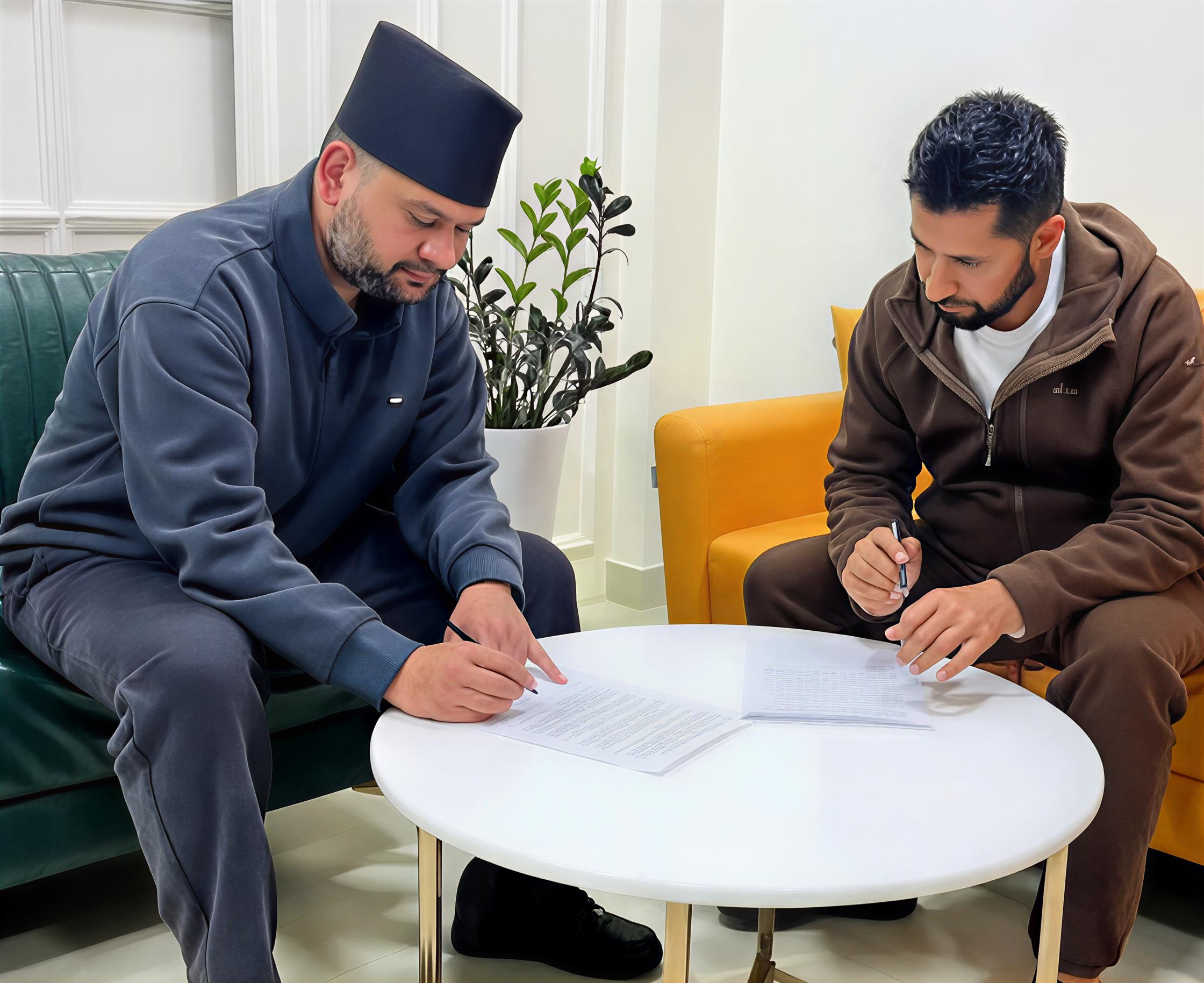
Kathmandu — Rastriya Swotantra Party (RSP) President Rabi Lamichhane and Kathmandu Metropolitan City Mayor Balendra Shah (Balen) have signed a seven-point agreement, formally uniting their political paths ahead of the upcoming House of Representatives elections.
Under the agreement reached early Sunday morning, Rabi Lamichhane will continue as the president of the Rastriya Swotantra Party, while Balen Shah will lead the parliamentary party and be projected as the party’s future prime ministerial candidate.
Party name, symbol and flag remain unchanged
According to the agreement, the name, flag and election symbol of the Rastriya Swotantra Party will remain unchanged. The party will continue to contest elections under the bell symbol, with its central office remaining in the Kathmandu Valley.
Although both leaders currently hold official positions, the agreement was signed only by name, without mentioning their respective titles. Following the agreement, political discussions have intensified regarding Balen Shah’s possible transition into active party politics, though no formal decision has been announced.


Commitment to anti-corruption movement
The first point of the agreement states that both sides will take ownership of the youth-led (Gen-Z) movement against corruption and misgovernance. The leaders have pledged to address the demands of families of those injured and killed during the movement.
The agreement also commits the RSP to policy, institutional and structural reforms aimed at economic growth, social justice and good governance, with the goal of transforming Nepal into a respectable middle-income country within the next ten years.
Leadership roles defined
The agreement clearly defines leadership responsibilities within the party.
“Rabi Lamichhane will remain the central president of the Rastriya Swotantra Party, and Balendra Shah will be the leader of the parliamentary party and the future prime ministerial candidate after the upcoming House of Representatives elections,” the document states.
It also emphasizes expanding the party’s organizational structure by integrating young activists and experienced experts, with responsibilities assigned on the basis of competence, inclusiveness and public trust.
Election Commission updates and candidate preparation
Both sides have agreed to update party records and documents with the Election Commission in line with the agreement. Sources say proportional representation candidates associated with Balen Shah will contest elections under the RSP banner, and the proportional list may be submitted within the next few days by mutual agreement. Nominations for direct constituencies are still several weeks away.
Call for broader alternative political unity
The agreement calls on other reform-oriented and alternative political forces, groups and individuals to rally around the principles, leadership and election symbol of the Rastriya Swotantra Party to advance democratic governance, development and social justice.
While previous discussions involved other political figures and groups, including Kulman Ghising, the agreement does not explicitly mention them, leaving scope for future political alignment.
Agreement signed after Rabi’s release
Political discussions gained momentum after Rabi Lamichhane’s release from custody, following an order by the Butwal bench of the Tulsipur High Court. Multiple rounds of talks between Lamichhane and Shah preceded Sunday’s agreement.
After the agreement, Lamichhane said:
“Consensus should be based on what the country needs, not what leaders want.”
He shared the message publicly on social media.
Witnesses and reactions
Several RSP leaders, youth activists and artist witnessed the signing, including Vice President DP Aryal, leaders Swarnim Wagle, Shishir Khanal and Asim Sah, youth leader KP Khanal, and artist Nischal Basnet. After signing the agreement, Lamichhane and Shah embraced and posed for a group photograph.
Reacting to the development, Interim Election Government Spokesperson and Minister for Communications Jagadish Kharel described it as a “new beginning.”
In a Facebook post, Kharel wrote:
“New day, new beginning. The dream of a beautiful and prosperous Nepal—the destination is being decided.”
Contents of the 7-Point Agreement
- Taking ownership of the youth-led movement against corruption and misgovernance, we pledge to appropriately address the demands of the families of those injured and martyred.
- To remain sincerely committed to the faithful implementation of a roadmap to make Nepal a respectable middle-income nation within the next ten years, based on economic and social advancement and civilized political practices, through deep policy, institutional and structural reforms aimed at achieving national objectives of prosperity and social justice.
- The name of the political party to be established after broad unity between the first party and the second party shall be the Rastriya Swotantra Party. The party flag shall remain the same as before, featuring a blue bell at the center of a white circle on a blue background. The party’s election symbol shall be the bell, and the central office shall be located in the Kathmandu Valley.
- Rabi Lamichhane shall remain the central president of the Rastriya Swotantra Party, and Balendra Shah shall be the leader of the parliamentary party and the future prime ministerial candidate following the upcoming House of Representatives elections.
- To make the party’s organizational structure more capable and expansive after the grand unification, appropriate adjustments shall be made by incorporating young activists and experienced experts, with responsibilities assigned on the basis of competence, inclusiveness and public image.
- To update all documents related to the Rastriya Swotantra Party with the Election Commission in accordance with this agreement.
- To call upon other cultured and transformative alternative political forces, groups and individuals to rally around the principles, leadership and election symbol of the Rastriya Swotantra Party—the bell—and advance the agenda of democratic good governance, progress and social justice.