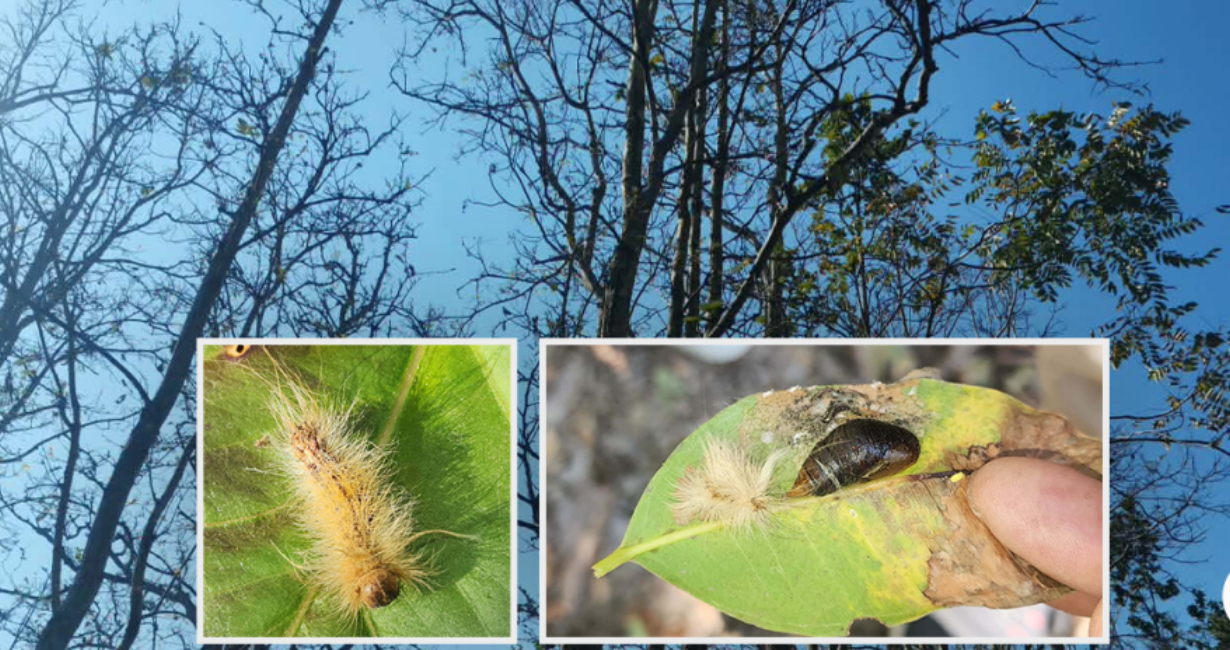
Kathmandu—The widespread damage seen in Sal (Shorea robusta) forests across Dang, Dailekh, and Surkhet in western Nepal has been confirmed as a severe defoliator insect infestation, not forest fire, according to a detailed scientific study conducted by the Forest Research and Training Center under the Ministry of Forests and Environment.
The investigation was launched after reports from media and local stakeholders indicated that forest areas which should have appeared lush and green during spring had instead turned brown and leafless. The sudden and unusual condition raised serious concerns about a possible forest disaster.
A three-member expert team coordinated by Deputy Secretary Sunita Ulak, and comprising Tribhuvan University Professor Dr. Prem Budha and research officer Pratik Pandey, carried out on-site inspections in coordination with Karnali Province’s Ministry of Forests and Environment, provincial directorates, and local Division Forest Offices. The team surveyed multiple community forests in Dailekh, including Kimugaun, Chupra, Kotila, Sreesthan, Belpata, Sadu, Chhare, Jamune, and Torya, where Sal trees were found completely stripped of leaves.
The study concluded that the damage was caused by hairy larvae belonging mainly to the Erebidae and Lasiocampidae families. These defoliator insects feed aggressively on Sal leaves, leaving entire forest patches bare. Similar infestations were also observed in Dang district, where around 10 percent of Sal trees in the community forests of Tulsipur, Babai, and Dangisharan areas were found affected. In some locations, the damaged Sal forest alone covered an estimated 193 hectares.

Forest experts noted that while Sal trees were heavily impacted, adjacent pine trees remained untouched, indicating that the insects are highly species-specific and depend almost entirely on Sal trees for survival. According to Dr. Budha, although there are hundreds of leaf-eating insect species, only a few have the capacity to cause such large-scale ecological damage. The insect responsible in this case is believed to be the larval stage of a moth or butterfly species locally known as Jhusilkira.
These insects typically emerge as adult moths during Chaitra–Baishakh and lay eggs on Sal leaves. The larvae that hatch undergo multiple molting stages while feeding intensively on leaves, before pupating and emerging as adults. During the recent field visit, live larvae were no longer present, but large quantities of shed skins and pupal shells were found, indicating that the outbreak had already passed its most active phase.
Experts have linked the severity of this year’s outbreak to prolonged drought, lack of winter rainfall, and rising temperatures, particularly in south- and west-facing hill forests. Similar pest outbreaks have been recorded in other countries with Sal forests, such as Cambodia, during drought conditions. Officials noted that a comparable infestation occurred about three years ago and subsided naturally after rainfall.
The outbreak is believed to have begun around Asoj, but delayed reporting meant that authorities were informed only after the damage had become extensive. According to Deputy Secretary Ulak, local communities may have initially considered the phenomenon a normal natural process, while past experiences of limited technical support discouraged early reporting. As a result, opportunities for early identification and control were missed.
Beyond ecological damage, the infestation has also affected local livelihoods and cultural practices. Sal leaves are widely used for religious rituals, festivals such as Dashain and Tihar, weddings, and for making traditional leaf plates and bowls. Locals reported that not a single usable Sal leaf was available during the recent festive season, causing cultural and economic distress.
The study also observed that natural predators of the insects were present, indicating some level of biological control. However, experts warned that natural regulation alone is insufficient during extreme climatic conditions or when insect populations surge abnormally.
The expert team has recommended preventive and mitigation measures, including forest cleaning and pruning around Bhadra–Asoj, limited and controlled burning to destroy insect remnants in the soil, and the use of light traps as temperatures begin to rise from Falgun onward. Division Forest Offices have been instructed to remain alert, train community forest user groups, and ensure early reporting of similar symptoms.
Although the current active phase of the infestation has ended, experts caution that the outbreak could recur next year if weather conditions remain favorable for the insects. Authorities have been advised to collect live samples if larvae reappear, particularly during late winter and early spring, so the exact species can be identified through laboratory rearing.
The Forest Research and Training Center plans further field visits in February and March to monitor the situation, identify the insect species conclusively, and develop long-term management strategies to protect Nepal’s Sal forests from future outbreaks.