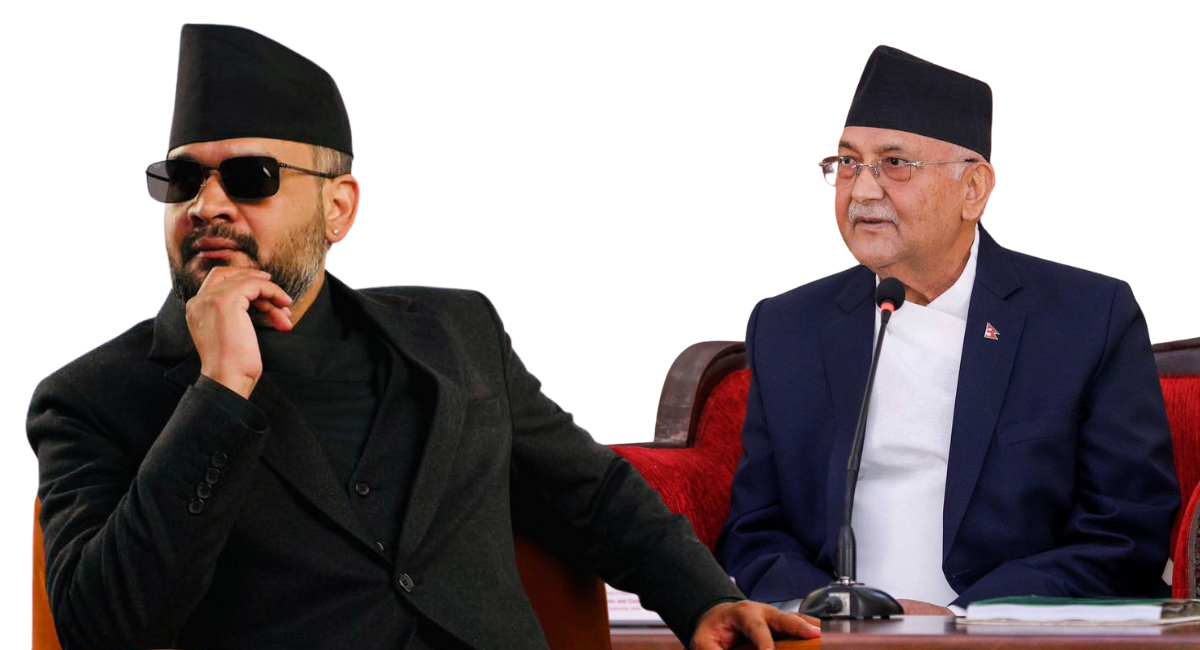
Kathmandu- As the Falgun 21 House of Representatives election approaches, the report of the commission investigating the Gen-z Movement has begun to surface as a major political agenda, particularly in Jhapa Constituency No. 5, where UML Chairperson KP Sharma Oli and Rastriya Swatantra Party-backed candidate Balendra (Balen) Shah are in direct contest. With both leaders vying for the prime ministerial post, Jhapa-5 has turned into one of the most closely watched constituencies in the country.
The rivalry between Oli and Balen, strained for nearly three years, has intensified during the election campaign. Their conflict, rooted in differing roles and accusations related to the Gen-z Movement of Bhadra 23 and 24, has increasingly dominated political discourse. While Balen has publicly held Oli responsible for the deaths during the movement, Oli has rejected the allegations and instead blamed Balen and his supporters for violence and arson.
The government had formed a commission of inquiry under the leadership of former judge Gauri Bahadur Karki to investigate the incidents of Bhadra 23 and 24. The commission’s initial three-month tenure has already been extended twice, and its current deadline is set to expire on Magh 29, requiring submission of the report by Magh 28. Despite repeated assurances, concerns persist over whether the report will be completed within this timeframe.
Commission spokesperson Bigyanraj Sharma has stated that the report writing is in its final stage and will be submitted within the deadline. However, similar assurances were made before the first extension expired, raising doubts among political actors and observers. UML leaders, in particular, have expressed frustration over the delay, arguing that continued uncertainty is allowing what they describe as a campaign of misinformation against Oli.
UML leaders say Oli is keen for the report to be made public before the election to establish that he did not order security forces to open fire and that the deaths during the Gen-z Movement were not the result of his directives. According to a senior UML leader, the party believes the report would help clarify responsibilities and counter allegations being circulated on social media during the campaign.
Initially, the UML had opposed the formation of the inquiry commission and had even approached the Supreme Court seeking to halt its work. However, after the court refused to issue a stay order, Oli eventually provided his statement when commission members visited his residence. Since then, UML leaders say they have been pressing for the report’s early completion.
Oli himself has publicly voiced dissatisfaction with the delay. In a recent video message, he stated that he had expected the inquiry commission’s report to expose the falsity of allegations against him, but felt compelled to speak out as the commission failed to deliver even after two deadline extensions. In the video, Oli argued that the Gen-z Movement initially began peacefully and that violence escalated only after protesters were led towards restricted areas, which, under the law, compelled security forces to respond.
Although Oli did not name Balen directly, UML leaders and supporters have consistently accused Balen of inciting agitation and contributing to large-scale destruction, including attacks on state institutions and heritage sites. Complaints have been filed from both sides, with one camp seeking murder charges against Oli and the then home minister, while the other has accused Balen and his associates of arson and vandalism. These complaints remain pending as police continue to assess available evidence.
Both political camps appear eager to use the commission’s findings as an election narrative. UML leaders argue that clarity from the report would help them approach voters with a clear account of responsibility, while Balen’s supporters maintain that accountability for the violence must be established irrespective of political timing.
Despite political pressure, the government has indicated it may extend the commission’s tenure again if necessary. A source close to the prime minister said that the credibility and clarity of the report are more important than meeting an election-driven deadline.
However, some security and legal experts have warned that the timing of the report could itself affect the election environment. A former Inspector General of Police noted that depending on its conclusions, the report could provoke unrest or political backlash, potentially disrupting the electoral process. In contrast, former Supreme Court Justice Balram KC has argued that the report should not influence the election in a system governed by the rule of law, stressing that legal processes must be respected regardless of political outcomes.
The commission has recorded statements from nearly 200 individuals, including senior political leaders, government officials, security personnel, and movement leaders. Written responses have also been received from top constitutional figures and former prime ministers. With extensive documentation and testimonies already collected, the commission now faces mounting pressure to finalize a report that carries significant legal, political, and electoral implications.